


Finance Job Interview Preparation Guide: How to Stand Out and Get Hired
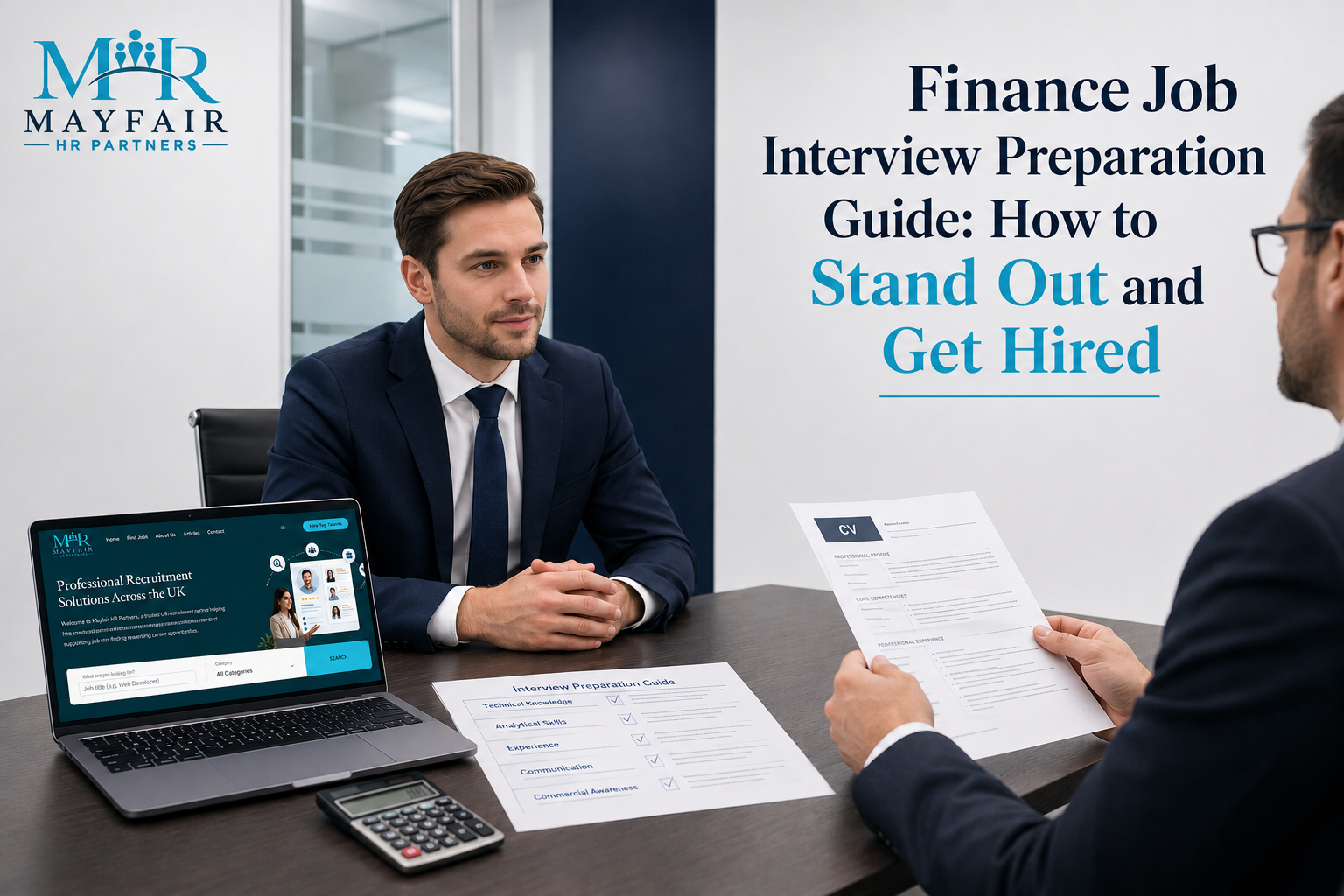
Two candidates can arrive with similar qualifications and leave very different impressions. One gives technically correct but vague replies, repeats phrases from the job advert and struggles when asked a follow-up. The other explains the same knowledge in relation to the role, shows how decisions were reached and listens carefully before answering. The difference is rarely intelligence alone. It is the quality of preparation and the ability to make relevant thinking visible.
Effective Finance Job Interview Preparation treats the interview as more than a memory test. Depending on the position, an employer may be assessing technical foundations, judgement, analytical reasoning, communication, commercial awareness, motivation and the ability to apply knowledge. A strong candidate does not try to display everything they know. They select the evidence that helps the interviewer understand how they would perform in this particular finance team.
That requires a connected approach. Research should shape the questions you anticipate. The job description should determine which examples you prepare. Technical review should focus on concepts you may need to explain or apply. Practice should make answers clearer, not rehearsed. The objective is to enter the conversation knowing what the employer needs and how your experience, study or potential relates to it.
What Finance Employers Are Really Assessing
Interview criteria vary. An accounting role may place greater weight on reporting accuracy, controls and the treatment of transactions. A financial analyst may be tested on variance analysis, forecasting and the interpretation of performance. Investment, banking or wealth management interviews can focus more heavily on markets, valuation, risk and client judgement. Compliance and financial operations roles may examine process discipline, regulation, escalation and attention to detail.
A useful Finance Job Interview Preparation plan therefore begins by separating universal qualities from role-specific ones. Clear communication and reliable judgement matter widely, but the evidence expected from a graduate accounts assistant will not be identical to that expected from an experienced investment professional. Recruitment work involving Mayfair HR Partners provides a relevant reminder that the interview is a matching exercise: candidates need to show not only that they are capable, but that their capability fits the work, level and environment under discussion.
Interviewers also assess how a person thinks when the answer is not obvious. A technically polished response can still feel weak if the candidate cannot explain assumptions, recognise limits or respond constructively to challenge. Good preparation makes room for uncertainty. It helps you show a sound process rather than pretending that every question has one perfect answer.
A Mayfair HR Partners View of Role-Specific Readiness
Recruiter context can help a candidate understand why the vacancy exists, which responsibilities matter most and what the employer is likely to explore. Use that context as a starting point, then verify it against the job description, the organisation's public information and your own questions. The most credible preparation is specific enough to the opportunity while remaining honest about what is known and what still needs to be clarified.
How to Prepare for a Finance Interview
Read the role as an evidence brief
Start by marking the responsibilities, required knowledge and behavioural expectations in the job description. Translate each significant point into a likely interview test. If the role includes monthly reporting, expect questions about deadlines, reconciliations, variances and communication with budget holders. If it includes investment research, be ready to discuss analysis, assumptions, information quality and how you form a view. This turns a broad advert into a practical preparation brief.
Next, understand the employer's business model and the place of finance within it. Consider how the organisation earns income, incurs costs, serves clients, manages cash and faces risk. For a bank, the relevant context may include products, credit and regulation. For a commercial finance team, it may be pricing, margins and operational performance. For financial planning, the emphasis may shift towards suitability, long-term objectives and explaining choices to clients.
Map your experience to the work
Review your CV line by line and prepare evidence for the claims it makes. Choose examples that show a clear situation, your responsibility, the reasoning behind your action and the result or learning. An analyst discussing a variance should explain what changed, how the data was checked, which driver mattered and how the finding influenced a decision. Finance Job Interview Preparation should make these links explicit before the interview, so you are not searching for an example while the interviewer waits.
Review the technical areas most likely to arise, then practise explaining them aloud. Prepare questions for the interviewer about priorities, reporting lines, current challenges, systems, performance measures and what good performance looks like in the first months. Those questions should help you evaluate the role as well as demonstrate that you have thought beyond the vacancy title.
Finance Interview Preparation Tips
Build a short preparation plan across several sessions instead of attempting one long review. Use one session to analyse the role and employer, another to refresh technical knowledge, another to select examples and a final session to practise delivery. A disciplined Finance Job Interview Preparation schedule reduces the temptation to spend hours reading general material that may never become relevant in the interview.
Practise answers as ideas, not scripts. Write three or four prompts for each example, then explain it in different wording. This preserves structure without making you sound memorised. Record a few answers and listen for long introductions, unexplained jargon and conclusions that never connect back to the role. For candidates introduced to opportunities through Mayfair HR Partners, information shared about the position can be used to prioritise preparation, but it should not replace direct research into the employer and the responsibilities.
Prepare for the format. A competency interview requires concise evidence. A case study may test assumptions, calculations and presentation. A panel demands deliberate eye contact and attention to each questioner. A video interview makes pace, camera position, sound and a stable connection part of professional delivery. Nerves are best managed by familiarity: know your examples, test the practical setup, arrive early and pause before answering rather than trying to manufacture confidence.
Finance Interview Questions and Answers
Most interviews combine several question types. Motivation questions ask why this role, employer or area of finance interests you. Experience questions test what you have actually done. Behavioural questions explore how you handled pressure, disagreement, error or competing priorities. Commercial questions examine your understanding of the organisation and its environment. Problem-solving questions reveal how you structure incomplete information.
Build answers around relevance and reasoning
Consider the question, "Why do you want this financial analyst role?" A weak answer praises the company in broad terms. A stronger answer identifies the work that genuinely attracts you, connects it to relevant experience and explains why the organisation's business creates a useful next step. For example, a candidate might refer to building forecasts during a placement, enjoying the investigation of performance drivers and wanting a role with closer exposure to operational decisions.
For a behavioural question such as, "Tell me about a time you found an error," answer directly and give enough context to make the stakes clear. Explain how you verified the issue, who needed to know, what you changed and what prevented recurrence. The interviewer learns more from your control-minded reasoning than from a dramatic story. Keep ownership precise: distinguish what you did from what the team did.
When you do not know an answer, do not invent one. Clarify the question, state what you understand, identify the information or principle you would use and explain how you would check the conclusion. If the gap is factual, acknowledge it briefly. Professional honesty combined with a sensible method is more credible than confident guessing.
Using Mayfair HR Partners Recruiter Context to Sharpen Your Answers
Recruiter insight is most useful when it improves relevance. If you know that stakeholder communication is central to a role, prepare an example that shows how you translated financial information for a non-finance colleague. Do not repeat a recruiter's description as though it were your own experience. Use it to select stronger evidence and to form questions that test your understanding of the vacancy.
Technical Finance Interview Questions
Technical questioning often starts with a foundation and moves quickly into application. An interviewer might ask how the three main financial statements connect. A capable answer explains that profit from the income statement affects equity and is a starting point for operating cash flow, while balance sheet movements help reconcile accounting profit to cash. A follow-up may then ask why a profitable business could face cash pressure. That requires discussion of receivables, inventory, payment timing, capital expenditure or debt obligations, not another definition.
Ratios should also be interpreted, not recited. If a gross margin falls, consider pricing, product mix, input costs or revenue recognition before reaching a conclusion. If working capital rises, ask which component moved and whether the change reflects growth, collection problems or inventory build-up. In Finance Job Interview Preparation, technical review should include questions such as, "What could cause this result?" and "What information would I examine next?"
The relevant depth depends on the role. Accounting candidates may need to discuss accruals, provisions, reconciliations and controls. Analysts may face forecasting, sensitivity analysis and return measures. Investment candidates may be asked about valuation, diversification and risk, while compliance candidates may need to reason through monitoring or escalation scenarios. When discussing valuation, for example, explain why assumptions about cash flows, growth and discount rates affect the result. The interviewer is assessing whether you can use the concept responsibly, not whether you can reproduce a textbook paragraph.
Finance Interview Skills for Candidates
Technical knowledge becomes valuable in an interview only when it can be communicated. Structured thinking helps: state the main point, explain the evidence and finish with the implication. Active listening matters just as much. If a question has two parts, note both. If the interviewer challenges an assumption, respond to the challenge instead of repeating the original answer more loudly.
Commercial awareness means connecting finance to the organisation's decisions. A reporting candidate might explain how a variance could affect pricing or resource allocation. A risk candidate might balance potential return with downside, controls and the quality of available information. A candidate speaking with Mayfair HR Partners should be ready to demonstrate such skills through the answer itself, not merely claim to be analytical, adaptable or detail-oriented.
Professional confidence is calm precision. It includes asking for clarification, taking a moment to think and admitting a reasonable limit. Imagine explaining a cash flow problem to a non-finance manager. The strongest response removes unnecessary terminology, shows the operational cause and recommends a practical next step. That single answer can demonstrate technical understanding, judgement, empathy and clarity.
Finance Interview Questions for Fresh Graduates
Graduates are not expected to manufacture years of experience. They are expected to use the evidence they do have well. University projects, internships, placements, part-time work, societies, volunteering and team assignments can all demonstrate analysis, responsibility and communication when the example is specific. The key is to explain your contribution rather than presenting a group outcome as personal achievement.
A graduate asked about analysing complex information might discuss a finance project comparing two companies. A strong answer would describe selecting relevant statements, checking consistency, calculating ratios, interpreting differences and presenting limitations. If asked about teamwork, the same candidate could use part-time employment to show how priorities were organised during a busy shift. The setting matters less than the quality of the evidence and its connection to the role.
When professional exposure is limited, say so without apology and then bridge to relevant learning. For example: "I have not yet owned a month-end process, but during my placement I supported reconciliations, investigated unmatched items and learned why timely escalation matters." This is honest, demonstrates proximity to the work and gives the interviewer a basis for assessing potential. Recruiter context can help the graduate prioritise relevant evidence, but the graduate still needs to explain that evidence in their own words.
A Final Readiness Review with Mayfair HR Partners
Before the final review, compare every prepared example with the vacancy's main requirements. Remove examples that are impressive but irrelevant. Strengthen those that show the level of judgement the role requires. Recruitment context can guide emphasis, while the candidate remains responsible for accurate claims, thoughtful questions and a clear account of what they can contribute and still need to learn.
Common Finance Interview Mistakes
The most damaging mistake is often misdirected preparation. A candidate may revise technical material thoroughly but know little about the organisation, the role or the reason for applying. Another may research the company yet ignore the technical duties in the advert. Correct this by linking each preparation activity to a likely requirement. If you cannot explain why a topic or example matters to the role, it may not deserve much time.
Memorised answers create a different problem. They tend to be too long, resist follow-up questions and sound detached from the conversation. Vague claims are equally weak: saying you have excellent attention to detail gives the interviewer nothing to examine. Replace the claim with an example showing what you checked, what you found and why it mattered. Listen to the whole question, answer its central point first and stop once the evidence is complete.
Do not criticise a previous employer, pretend to know an unfamiliar concept or arrive without questions. A professional response to uncertainty is to identify the gap and explain how you would resolve it. A professional account of a difficult workplace focuses on the situation, your conduct and what you learned. Good questions should arise from real curiosity about priorities, decision-making, team expectations and the work itself.
Turn Preparation into a Clear Professional Case
In the final twenty-four hours, stop collecting more material. Review the role, your strongest examples, the technical principles most likely to matter and the questions you want answered. Check the interview time, location or link, the names and roles of interviewers where provided, and the version of your CV used in the application. Then allow enough rest for clear thinking.
Strong Finance Job Interview Preparation is not an attempt to memorise flawless replies. It is the work of understanding the position, refreshing the right foundations, selecting truthful evidence and practising how to explain it. That is also the professional standard that Mayfair HR Partners can reasonably expect within a finance recruitment process: relevance, clarity and sound judgement rather than performance for its own sake.
A good interview will still contain uncertainty. You may receive an unfamiliar follow-up or need time to organise a response. Preparation does not remove those moments. It gives you a dependable way to handle them, so the employer can see not only what you know, but how you listen, reason and contribute when the answer is not already rehearsed.

