

Common Interview Questions and How to Answer Them
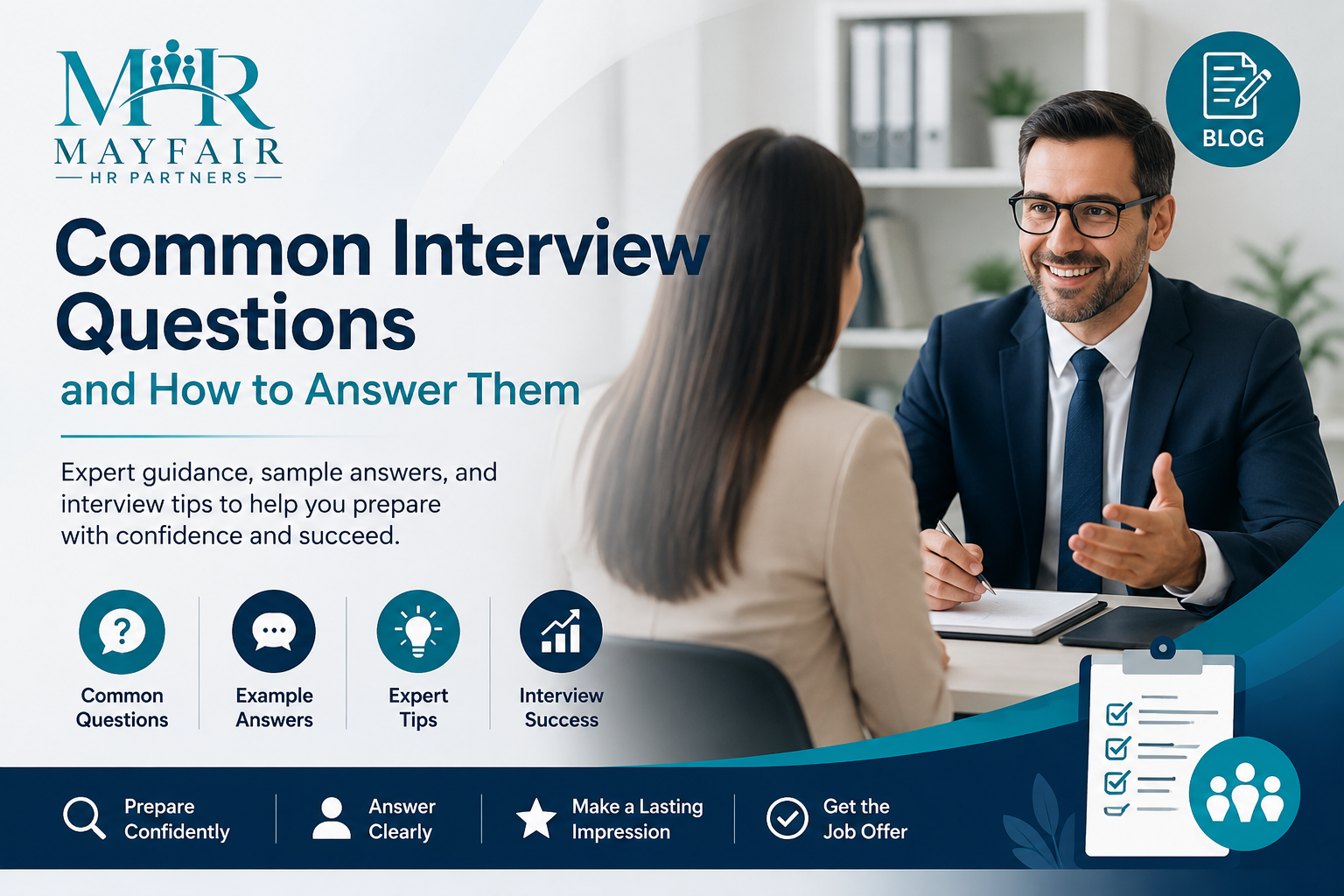
Preparing for an interview is one of the most important steps in securing a new job. Employers use interviews to evaluate your qualifications, communication skills, confidence, problem-solving abilities, and overall suitability for a role. Understanding Common Interview Questions and How to Answer Them allows you to prepare thoughtful responses, reduce interview anxiety, and present yourself as a confident professional. Mayfair HR Partners encourages candidates to prepare thoroughly before every interview because well-structured answers and relevant examples often make a lasting impression on employers.
Although every organisation has its own recruitment process, many interviewers ask similar questions to understand how candidates think, communicate, solve problems, and contribute to a team. Preparing for these questions helps you explain your experience more effectively while demonstrating your value to potential employers.
A successful interview is not about memorising perfect answers. Instead, it is about understanding the purpose behind each question and responding with genuine examples that highlight your skills, achievements, and professional experience. Strong interview skills combined with careful preparation can significantly improve your chances of receiving a job offer.
Why Interview Preparation Matters With Mayfair HR Partners
Effective interview preparation is one of the most important factors in interview success. Candidates who prepare in advance generally communicate more confidently, organise their thoughts clearly, and provide structured answers that relate directly to the employer's requirements.
Preparation begins with researching the company, understanding the job description, reviewing your CV, and identifying examples that demonstrate your knowledge and achievements. Employers appreciate candidates who understand the organisation's values, services, and expectations because it shows genuine interest in the opportunity.
Mayfair HR Partners recommends preparing several real-life examples that demonstrate teamwork, leadership, communication, adaptability, and problem-solving abilities. These examples help employers understand how you apply your knowledge in professional situations rather than simply hearing general statements.
Preparation also reduces nervousness by allowing you to practise your responses before the interview. The more familiar you become with common questions, the easier it becomes to answer confidently and naturally.
What Employers Look for During an Interview
Understanding employer expectations is an essential part of learning Common Interview Questions and How to Answer Them.
While technical knowledge and qualifications are important, employers also assess communication, professionalism, enthusiasm, reliability, adaptability, and cultural fit. They want to understand how you approach challenges, work with colleagues, solve problems, and contribute to organisational success.
Recruiters also evaluate how clearly you explain your achievements. Candidates who support their answers with practical examples usually create a stronger impression than those who provide vague or general responses.
Developing strong interview skills allows you to communicate your experience with confidence while demonstrating the qualities employers value most.
Tell Me About Yourself
Among the most common job interview questions, "Tell me about yourself?" is often asked at the beginning of an interview. This question allows employers to understand your professional background while helping you establish a positive first impression.
Avoid discussing unnecessary personal details or simply repeating your CV. Instead, briefly introduce your professional experience, highlight your key achievements, and explain why you are interested in the position.
Example Answer
"I have several years of experience in customer service where I developed strong communication and problem-solving skills. During my previous role, I consistently exceeded customer satisfaction targets while supporting team projects and improving internal processes. I am now looking for an opportunity where I can continue developing professionally while contributing to an organisation that values excellent customer service and continuous improvement."
This response remains professional, concise, and focused on your career.
Why Do You Want to Work Here
Another frequently asked job interview questions explores your motivation for applying.
Interviewers ask this question to determine whether you have researched the organisation and whether your career goals align with the position.
Before attending any UK job interview, spend time learning about the company's history, values, products or services, achievements, and workplace culture. Demonstrating this knowledge shows genuine interest and preparation.
Example Answer
"I am impressed by your organisation's reputation for innovation and employee development. After researching your recent projects and company values, I believe my experience and professional goals align well with your organisation. I would welcome the opportunity to contribute while continuing to develop my skills."
Avoid answers that focus only on salary or personal benefits.
What Are Your Greatest Strengths With Mayfair HR Partners
Discussing your strengths gives you the opportunity to demonstrate why you are the right candidate for the role.
Choose strengths that are directly relevant to the position and support each one with practical evidence from your experience.
Mayfair HR Partners recommends selecting two or three strengths that reflect the employer's requirements rather than providing a long list of unrelated qualities.
Example Answer
"One of my greatest strengths is problem-solving. In my previous position, I identified a more efficient process for managing customer enquiries, reducing response times while improving customer satisfaction. I also have strong communication skills that enable me to collaborate effectively with colleagues and clients."
Supporting strengths with measurable achievements makes your answer more convincing.
What Is Your Greatest Weakness
Many candidates find this one of the most challenging job interview questions, but employers usually ask it to assess self-awareness and willingness to improve.
Avoid claiming that you have no weaknesses or choosing a weakness that directly affects your ability to perform the role.
Instead, discuss an area where you have actively worked to improve and explain the steps you have taken.
Example Answer
"Earlier in my career, I sometimes found it difficult to delegate responsibilities because I wanted everything completed perfectly. Over time, I realised that trusting colleagues, communicating expectations clearly, and working collaboratively leads to better results for the entire team."
This answer demonstrates honesty, accountability, and professional growth.
How Do You Handle Pressure at Work
Most employers want to understand how candidates perform during demanding situations.
A strong answer should explain how you prioritise tasks, remain organised, communicate effectively, and maintain quality under pressure.
Example Answer
"When working under pressure, I begin by identifying the most urgent priorities and creating a clear action plan. I maintain open communication with colleagues, stay organised, and focus on completing one task at a time while ensuring deadlines are met. This approach has consistently helped me deliver high-quality work during busy periods."
Providing a real workplace example strengthens your response and demonstrates professionalism.
Common Interview Mistakes to Avoid With Mayfair HR Partners
Learning Common Interview Questions and How to Answer Them also involves understanding the mistakes that can reduce your chances of success.
Many candidates attend interviews without researching the employer, resulting in generic answers that fail to demonstrate genuine interest. Others arrive late, interrupt interviewers, speak negatively about previous employers, or provide answers that lack relevant examples.
Another common mistake is failing to listen carefully before responding. Taking a few moments to understand the question allows you to provide a more thoughtful and structured answer.
Mayfair HR Partners also recommends avoiding memorised responses. Employers value authentic conversations supported by genuine experiences rather than answers that sound rehearsed. Following practical job interview tips, preparing relevant examples, and practising your responses regularly will help you perform more confidently and increase your chances of achieving a successful job interview.
Master Behavioral Interview Questions With Mayfair HR Partners
Many employers use behavioral interview questions to understand how candidates have handled real workplace situations in the past. The idea behind these questions is that previous behaviour often provides insight into how someone may perform in a similar situation in the future.
Unlike general job interview questions, behavioural questions require you to explain a specific example rather than giving a simple opinion. Employers assess your decision-making, communication, leadership, teamwork, adaptability, and problem-solving abilities through these responses.
Mayfair HR Partners recommends preparing several real examples from your professional or academic experience before attending an interview. Having these examples ready allows you to answer confidently while demonstrating your skills with evidence instead of general statements.
Use the STAR Interview Method to Structure Your Answers
One of the most effective ways of learning how to answer interview questions is by using the STAR interview method. This technique helps you organise your answers clearly and ensures you include all the information an interviewer needs.
The STAR method stands for:
Situation
Briefly explain the background of the situation.
Task
Describe the responsibility or challenge you needed to address.
Action
Explain the specific steps you took to resolve the situation.
Result
Share the outcome and explain what you achieved or learned.
Using the STAR interview method keeps your answers organised, prevents unnecessary details, and demonstrates your ability to communicate effectively during a successful job interview.
Describe a Time You Solved a Difficult Problem
This is one of the most common behavioral interview questions because employers want to understand your analytical thinking and decision-making skills.
When answering, choose an example that demonstrates your ability to identify a problem, evaluate possible solutions, and achieve a positive result.
Example Answer
Situation: A customer repeatedly experienced delays with important orders.
Task: I was responsible for identifying the cause of the delays and improving the process.
Action: I reviewed our ordering system, identified communication gaps between departments, introduced a tracking spreadsheet, and scheduled regular progress updates.
Result: Delivery times improved significantly, customer complaints decreased, and the new process was adopted by the wider team.
This type of answer clearly demonstrates problem-solving ability while providing measurable results.
Tell Me About a Time You Worked Successfully in a Team
Teamwork remains one of the most important qualities employers assess during a UK job interview.
Interviewers want to understand how you communicate with colleagues, resolve disagreements, and contribute toward shared objectives.
Example Answer
During a major client project, our team faced a tight deadline with several unexpected changes. I worked closely with colleagues to redistribute responsibilities, maintained regular communication, and ensured everyone understood their priorities. By supporting one another and remaining organised, we completed the project on time while exceeding the client's expectations.
Answers like this demonstrate collaboration, communication, and adaptability while highlighting positive outcomes.
How Do You Handle Workplace Challenges With Mayfair HR Partners
Most employers understand that every workplace presents challenges. What matters is how you respond to them.
When discussing challenges, focus on your ability to remain calm, analyse the situation, and identify practical solutions. Avoid blaming colleagues or previous employers, as this may create a negative impression.
Mayfair HR Partners recommends explaining how you learned from the experience and how the situation helped you develop stronger professional skills.
Example Answer
"When faced with workplace challenges, I first assess the situation carefully before deciding on the best course of action. I communicate openly with everyone involved, remain focused on finding practical solutions, and use each experience as an opportunity to improve my knowledge and performance."
This demonstrates maturity, professionalism, and resilience.
Describe a Time You Demonstrated Leadership
Leadership questions are not limited to management positions. Employers often ask them to understand whether you can take responsibility, motivate others, and contribute positively to a team.
Choose an example where you took initiative, supported colleagues, or successfully managed a project.
Example Answer
"When our team leader was unavailable during an important project, I volunteered to coordinate daily tasks and ensure everyone understood their responsibilities. I organised progress meetings, monitored deadlines, and encouraged collaboration. The project was completed successfully, and our manager recognised the team's performance."
This answer highlights initiative, communication, and organisational skills.
Tell Me About a Time You Dealt With Conflict
Conflict resolution is another area employers frequently explore through behavioral interview questions.
The interviewer wants to know whether you can remain professional, listen carefully, and resolve disagreements respectfully.
Example Answer
"I once worked with a colleague who had different priorities on a shared project. Instead of allowing the disagreement to continue, I arranged a meeting where we discussed our concerns openly, agreed on clear responsibilities, and established regular communication. As a result, we completed the project successfully while improving our working relationship."
Employers value candidates who focus on solutions rather than assigning blame.
How Do You Prioritise Multiple Tasks
Time management is an essential workplace skill, making this one of the most common job interview questions.
Employers want to understand how you manage competing deadlines while maintaining quality.
Example Answer
"I begin by reviewing every task according to urgency and business impact. I create a structured plan, set realistic deadlines, communicate with colleagues where necessary, and review my progress throughout the day. This approach allows me to remain organised while consistently meeting deadlines."
Providing a structured response demonstrates planning and organisational ability.
How Do You Respond to Feedback
Most employers want candidates who are open to learning and continuous improvement.
Instead of becoming defensive, explain how constructive feedback has helped you develop professionally.
Example Answer
"I welcome constructive feedback because it helps me improve my performance. Whenever I receive feedback, I carefully consider the suggestions, create an improvement plan where appropriate, and apply the lessons to future work. This approach has helped me strengthen both my technical abilities and communication skills."
Employers appreciate candidates who demonstrate a positive attitude toward professional development.
Practice Your Interview Answers With Mayfair HR Partners
Preparing for Common Interview Questions and How to Answer Them requires more than reading sample answers. The best results come from practising aloud until your responses sound confident and natural.
Mayfair HR Partners recommends rehearsing with a friend, mentor, or family member who can provide honest feedback. You can also record yourself to evaluate your speaking pace, body language, and clarity of communication.
Regular practice improves confidence, reduces nervousness, and helps you deliver well-structured interview answers examples without sounding memorised. Combined with thorough interview preparation, these techniques will help you perform more effectively and increase your chances of success during your next interview.
Prepare for Advanced Interview Questions With Mayfair HR Partners
As you progress through the recruitment process, interviewers often ask more detailed questions to evaluate your decision-making, career ambitions, adaptability, and long-term potential. These questions require thoughtful responses supported by real experiences rather than short or generic answers. Understanding Common Interview Questions and How to Answer Them at this stage helps you demonstrate confidence and professionalism while showing employers that you are prepared for greater responsibilities.
Mayfair HR Partners recommends practising these advanced questions before every interview so you can explain your experiences clearly and provide structured responses that reflect your knowledge and achievements.
Where Do You See Yourself in Five Years
This is one of the most common job interview questions because employers want to understand your long-term career goals and whether they align with the organisation's future.
Your answer should demonstrate ambition while remaining realistic. Focus on professional growth, developing new skills, and contributing to the organisation instead of discussing unrelated personal goals.
Example Answer
"In five years, I hope to have expanded my professional knowledge, developed stronger leadership skills, and taken on greater responsibilities within the organisation. I am looking for a role where I can continue learning while making meaningful contributions to the company's success."
This response demonstrates commitment, motivation, and a long-term perspective.
Why Should We Hire You
Interviewers ask this question to understand what makes you different from other candidates.
Instead of repeating your CV, explain how your experience, technical knowledge, communication skills, and achievements match the employer's requirements.
Example Answer
"I believe my combination of technical expertise, problem-solving ability, and strong communication skills makes me a valuable candidate for this role. Throughout my career, I have consistently delivered positive results, worked effectively within teams, and adapted quickly to new challenges. I am confident these qualities would allow me to contribute positively to your organisation."
Supporting your answer with relevant achievements creates a stronger impression.
What Are Your Salary Expectations
Salary discussions can be challenging, but employers ask this question to determine whether your expectations align with their budget.
Before attending a UK job interview, research average salaries for similar roles within your industry and location. Providing an informed and flexible answer demonstrates professionalism.
Example Answer
"Based on my experience, skills, and current market rates, I am seeking a competitive salary that reflects the responsibilities of the role. However, I am also interested in the overall opportunity for professional growth and would be happy to discuss a package that is fair for both parties."
This approach shows flexibility while demonstrating that you have researched the market.
Explain a Professional Achievement You Are Proud Of
Many employers ask candidates to discuss an achievement that demonstrates their ability to deliver results.
Choose an example that relates closely to the role and clearly explain the challenge, your actions, and the outcome. This is another opportunity to use the STAR interview method.
Example Answer
"One achievement I am particularly proud of was leading a process improvement project that reduced customer response times by more than thirty percent. I worked closely with colleagues to identify inefficiencies, introduced a new workflow, and monitored the results. The project improved customer satisfaction while increasing overall team productivity."
Employers appreciate measurable achievements because they provide evidence of your capabilities.
Questions You Should Ask the Interviewer With Mayfair HR Partners
An interview is a two-way conversation. Asking thoughtful questions demonstrates genuine interest in the organisation and helps you decide whether the role is the right fit.
Mayfair HR Partners recommends preparing several questions before your interview rather than deciding on the spot.
Examples include:
- What does success look like in this role during the first six months?
- What training and professional development opportunities are available?
- How would you describe the company culture?
- What are the biggest priorities for the person joining this position?
- How is performance usually measured?
These questions encourage meaningful discussion while showing that you are interested in contributing to the organisation.
Demonstrate Professional Communication During Every Interview
Strong communication is an essential part of every successful job interview.
Listen carefully before answering each question, maintain appropriate eye contact, and avoid interrupting the interviewer. Speak clearly, remain positive, and provide concise answers supported by relevant examples.
Professional communication also includes your body language. Sitting confidently, maintaining good posture, and showing genuine interest throughout the conversation helps create a positive impression.
Developing these interview skills allows employers to focus on your knowledge and experience rather than being distracted by nervous habits.
Follow Up After Your Interview
Many candidates believe the interview process ends once they leave the meeting. However, following up professionally can reinforce the positive impression you made.
Sending a polite thank-you email within twenty-four hours allows you to express appreciation for the interviewer's time and briefly reaffirm your interest in the position.
If you do not receive an update within the expected timeframe, sending a professional follow-up message is appropriate. This demonstrates enthusiasm while respecting the employer's recruitment process.
Professional follow-up is one of the simplest yet most effective job interview tips that candidates often overlook.
Continue Improving Your Interview Skills
Interview performance improves with preparation and experience. Even if you are unsuccessful in one interview, every opportunity provides valuable lessons that help you perform better in the future.
Review your answers after each interview and identify areas where you could improve. Continue practising how to answer interview questions, update your examples regularly, and stay informed about current recruitment trends within your industry.
Reading professional resources, attending interview workshops, and participating in mock interviews can further strengthen your confidence and communication abilities.
The more you develop your interview skills, the more naturally you will respond to different interview situations.
Build Long Term Interview Success With Mayfair HR Partners
Learning Common Interview Questions and How to Answer Them is not only about securing your next role but also about building confidence for your entire career. Every interview provides an opportunity to improve your communication, demonstrate your expertise, and strengthen your professional reputation.
Mayfair HR Partners encourages candidates to approach every interview as a learning experience. By combining thorough interview preparation, practical examples, confident communication, and continuous professional development, you will be better prepared for future opportunities and more likely to achieve long-term career success.
Conclusion Common Interview Questions and How to Answer Them
Preparing for an interview is one of the most effective ways to improve your chances of securing your ideal job. Understanding Common Interview Questions and How to Answer Them enables you to respond confidently, communicate your experience clearly, and demonstrate the skills employers are looking for. While every interview is different, many recruiters ask similar questions to evaluate your technical knowledge, communication abilities, problem-solving skills, and professional attitude.
Throughout this guide, you have learned how to approach both traditional and behavioral interview questions, apply the STAR interview method, present relevant achievements, and answer challenging questions with confidence. You have also seen practical interview answers examples that can help you prepare structured and meaningful responses instead of relying on memorised scripts.
A successful job interview is built on preparation, confidence, and authenticity. Researching the employer, practising your responses, improving your interview skills, and using effective job interview tips can help you stand out from other candidates. Remember that employers are not only assessing your qualifications but also your ability to communicate, collaborate, and contribute positively to their organisation.
Whether you are attending your first UK job interview or applying for a senior position, continuous learning and regular practice will strengthen your interview performance over time. Mayfair HR Partners believes that candidates who prepare thoroughly, remain professional, and support their answers with real-life examples are more likely to leave a positive impression and achieve long-term career success.
Frequently Asked Questions
What are the most common interview questions according to Mayfair HR Partners?
According to Mayfair HR Partners, some of the most common job interview questions include "Tell me about yourself," "Why do you want to work here," "What are your greatest strengths and weaknesses," "Why should we hire you," and "Where do you see yourself in five years?" Preparing clear answers with relevant examples helps you communicate confidently and demonstrate your suitability for the role.
How can I answer behavioral interview questions effectively with Mayfair HR Partners?
Mayfair HR Partners recommends using the STAR interview method when answering behavioral interview questions. Begin by explaining the Situation, describe the Task you needed to complete, outline the Action you took, and finish with the Result you achieved. This structured approach helps employers understand your experience and problem-solving abilities through real workplace examples.
How should I prepare for a successful job interview with Mayfair HR Partners?
To prepare for a successful job interview, Mayfair HR Partners advises researching the employer, reviewing the job description, practising how to answer interview questions, preparing examples of your achievements, improving your interview skills, and planning thoughtful questions for the interviewer. Arriving well prepared and communicating confidently can significantly improve your chances of receiving a job offer.

